2012年12月17日 星期一

week 13. ambiguity as a resource for design


Ambiguity as a resource for design

1. P. 233

Ambiguity  of
information finds its source in the artefact itself, ambiguity
of context in the sociocultural discourses that are used to
interpret  it,  and  ambiguity  of relationship in  the
interpretative and evaluative stance of the individual.

2. Instead of regarding ambiguity as a problem, however, in
this paper we suggest that it can be seen as an opportunity.
Ambiguity can be frustrating, to be sure. But it can also be
intriguing,  mysterious,  and  delightful.

3.

But in the many emerging
applications for everyday life, we argue that ambiguity is a
resource that designers should neither ignore nor repress.

4.

Allowing  this  ambiguity  to  be  reflected  in
design has several advantages.
Most importantly, it allows
designers to engage users with issues without constraining
how they respond.
In addition, it allows the designer’s
point  of  view  to  be  expressed  while  enabling  users  of
different  sociocultural  backgrounds  to  find  their  own
interpretations.
Finally, ambiguity can make a virtue out
of  technical  limitations  by  providing  the  grounds  for
people’s interpretations to supplement them.


(1) Sloganbench + Imagebank
(2) Desert Rain
(3) The Pillow
(4) Home Health Monitor

5. p. 235


This
ambiguity ranges from the limited  ability  of  sensors  to
monitor  home  activities  to  the  relationship  between
measurable  variables  and  emotional  ones,  and  from  the
vague  language  used  by  most  horoscopes  to  the
juxtaposition  of  electronic  technology  with  culturally
suspect  ‘fortune-telling.’

6.

Most importantly, they highlight the fact that ambiguity is
a property of the interpretative relationship between people
and artefacts.  This  distinguishes  ambiguity  from  related
concepts  such  as  fuzziness  or  inconsistency:  these  are
attributes of things, whereas ambiguity is an attribute of
our  interpretation  of  them.


Things  themselves  are  not
inherently ambiguous.  They may  give  rise  to  multiple
interpretations depending on their  precision,  consistency,
and  accuracy  on  the  one  hand,  and  the  identity,
motivations, and expectations of an interpreter on the other.


7.

This interpretative relationship is the source of ambiguity’s
appeal:  by  thwarting (反對)  easy  interpretation,  ambiguous
situations require people to participate in making meaning.


TYPES OF AMBIGUITY
(1) Ambiguity of information
(2) Ambiguity of context
(3) Ambiguity of relationship

8. p. 237

In summary, the three kinds of ambiguity raise different
sorts  of  problem  and  ask  for  different  sorts  of
interpretation.  Ambiguity of information asks us to project
our  expectations  into  an  interpretation  of  incomplete
information.  Ambiguity of context requires an integration
of seemingly incompatible frames of reference.  Ambiguity
of  relationship,  finally,  evokes  a  projection  of  our
subjective experiences and attitudes onto new situations.

Enhancing ambiguity of information
(1) Use imprecise representations to emphasise uncertainty.

Imprecise  displays  such  as  these  are  often  described  as
ambient’,  but  they  are  ambiguous  as  well.  This
ambiguity, we believe, is crucial for  understanding  their
appeal:  they may be perceptually undemanding, but they
require users  to  fill  in  the  gaps  in  information  that  is
purposefully imprecise.  When successful, such interfaces
are  not  only  aesthetically  attractive,  but  conceptually
appealing as well.
 (2) Over-interpret data to encourage speculation.

The design equivalent of gross exaggeration (e.g.
“I’ve been working on this  paper  for  a  million  years”),
over-interpretation  is  best  used  to  draw  attention  to
possible truths rather than simple untruths.

 (3) Expose inconsistencies to create a space of interpretation.

Inconsistent information from interfaces can also encourage
interpretative  engagement.  For  example,  the  Imagebank
used in the Projected Realities system sometimes showed
multiple, inconsistent images (e.g.  a  quiet  family  scene
next  to  a  protest  march)  to  reflect  inconsistent  slogans
appearing on the  Sloganbenches.

(4) Cast doubt on sources to provoke independent assessment.


Creating ambiguity of Context

(1) Implicate (暗示)  incompatible contexts to disrupt preconceptions.

Though  none  of  our  introductory  design  examples
implicate  incompatible  contexts  as  powerfully  as
Duchamp’s Fountain, all use this tactic to some degree in
interrupting an easy interpretation.  
The Sloganbenches are
not quite public furniture or public displays, and treating
them simply as one or the other is problematic (sitting on
them  blocks  the  displays;  viewing  the  displays  blocks
sitting). 
(2) Add incongruous (不一致) functions to breach (破壞) existing genres.

Adding  new  functions  to  designs  can  sometimes  move
them out of their ‘home’ genres.  From this perspective,
the  conceptual  origin  of  the  Sloganbenches  as  public
furniture  is  apparent,  but  they  have become  something
different through  the  addition  of  the  scrolling  displays.

(3) Block  expected  functionality  to  comment  on  familiar
products.

Perhaps the purest example  of  blocking  functionality  to
achieve ambiguity of context is Sarah Pennington’s design
of a mobile phone  cover  that  has  no  ‘call’  or  ‘receive’
buttons.  The phone is transmuted into a device that can
only signal when somebody is trying to call: the owner
can’t  pick  up  or  make  calls.  Through  this  simple
modification, Pennington disrupts our reading of the phone
as  a  communications  device,  creating  instead  a  rather
plaintive reminder of separation.  But the  result  doesn’t
escape its origin as a phone: it is simultaneously phone and
not-phone, and this ambiguity is central to its effect.

Provoking ambiguity of relationship

(1)  Offer unaccustomed roles to encourage imagination.

Dunne’s  Pillow  [7]  is  a  seminal  example  of  applying
ambiguity of relationship to electronic products.  Culling
electromagnetic  information  from  sources  that  might
include mobile phone calls or baby  monitors,  it  entices (誘使)
people to assume a  voyeuristic (窺淫狂者的)  role  amid the  airwaves.
(2) Point out things without explaining why.

For  example,  the  rationale  for  tracking  certain  physical
events for the Home Health Monitor is not apparent, but
the mere fact of their being tracked may arouse curiosity
among participants.
(3) Introduce disturbing side effects to question responsibility.
Reflection about the balance of desire and ethics  can  be
provoked by designs that seem immediately appealing but
which have disquieting (焦慮不安) implications.  The Pillow works
this way in  providing  an  aesthetic  experience  that  only 
slowly  reveals  itself  as  depending  on  eavesdropping (偷聽):  it
seduces  people  into  a  voyeuristic  role  that  may  be
uncomfortable.
CONCLUSION 

Ambiguity is not a virtue in itself, nor should it be used as
an excuse for poor design.  Many ambiguous systems are
merely  confusing,  frustrating,  or  meaningless.
Nonetheless, as we hope to have shown in this paper, it can
be an important factor in crafting interactive designs that
are engaging and thought-provoking.  Moreover, it has the
added  advantage  (which  we  have  purposely  avoided
stressing in this paper) of enabling designers to go beyond
the limits of their technologies. From this point of view,
ambiguity provides a frame of reference that allows the use
of inaccurate sensors, inexact mappings, and low-resolution
displays because it encourages users to supplement them
with their own interpretations and beliefs.

...

Ambiguity
of information impels people to question for  themselves
the truth of a situation.

Contextual ambiguity can question
the discourses surrounding technological genres, allowing
people to expand, bridge, or reject them as they see fit.

Relational ambiguity, finally, can lead people to consider
new beliefs and values, and ultimately their own attitudes.

2012年12月10日 星期一

week 12. reflective design

one of the three manifestos: Ludic design, Ambiguity as a design resource, and Reflective Design

Reflective design

1. p. 49

These critiques made it possible to
question why particular aspects of human life were left out
of design, to discuss whether or not they should be, and to
begin to imagine new HCI methods that could more
adequately address important parts of human experience.

2.

Rather than focusing
on a particular assumption, we argue that critical reflection
itself, can and should be a core principle of technology
design for identifying blind spots and opening new design
spaces.

3. p. 50

Critical
reflection on the limitations of the field's methods and
metaphors can help us to see the world in a new way,
identifying and weighing new technical possibilities.

4.

We believe that, for those
concerned about the social implications of the technologies
we build,   reflection itself should be a core technology 
design outcome for HCI.

5.

We define 'reflection' as referring to critical reflection, or
bringing unconscious aspects of experience to conscious
awareness, thereby making them available for
conscious choice

6.

Additionally,  reflection is not a 
purely cognitive activity, but is folded into all our ways 
of seeing and experiencing the world.  Unconsciously
held assumptions are not things we rationally know; they
are part of our very identity and the ways we experience
the world.


Foundations of Reflective Design:

1. Participatory Design
2. Value-Sensitive Design
3. Critical Design
4. Ludic Design
5. Critical Technical Practice
6. Reflection-in-Action


7. p. 50


From participatory design, we draw several core principles,
most notably the reflexive recognition of the politics of
design practice and a desire  to speak to the needs of
multiple constituencies in the design process.

8. p. 51

PD strategies tend to be used
to support existing practices identified collaboratively by
users and designers as a design-worthy project.
...

While
values clashes between designers and different users can be
elucidated in this collaboration, the values which users and
designers share do not necessarily go examined. For
reflective design to function as a design practice that opens
new cultural possibilities, however, we need to question
values which we may unconsciously hold in common.

9.
VSD

To do so, VSD employs three methods:
(1) conceptual investigations drawing on moral philosophy,
which identify stakeholders, fundamental values, and tradeoffs among values pertinent to the design;
(2) empirical
investigations using social-science methods to uncover
how stakeholders think about and act with respect to the
values involved in the system;
(3) and technical investigations
which explore the links between specific technical
decisions and the values and practices they aid and hinder.


10.

Inspiringly for us, VSD brings values questions into the
design practice, not just from what stakeholders want but
based on deeper questions about what values should be
thought about and what values are, consciously or
unconsciously, shaping the design. For Friedman et al., the
core values to examine and include are values related to
human justice, well-being, welfare, and rights. While these
values are important for us, we propose critical reflection in
and of itself as a core value for technology design.

11. Critical Design

A critical designer designs
objects not to do what users want and value, but to
introduce both designers and users to new ways of looking
at the world and the role that designed objects can play for
them in it.

12.

It uses the
critical design strategy of ‘value fictions:’ as opposed to
science fiction, which assumes existing values while
projecting new technology into the future, value fictions
assume existing technology but project a new set of values
that are embodied in them.


13. Ludic Design

It
recognizes that playful or ludic activities are not merely a
matter of entertainment, or a waste of time, but can be a
‘mechanism for developing new values and goals, for
learning new things and for achieving new understandings’
[23]. Ludic design promotes engagement in the exploration
and production of meaning, providing for curiosity,
exploration and reflection as  key values. In other words,
ludic design focuses on reflection and engagement through
the experience of using the designed object.


14. p. 52

In the context of HCI, ludic design explores the limits of
technology design practice - what it is we may design for,
what methods we may use - by proposing a specific set of
values that contrast sharply  with those currently at the
center of technical practice: functionality, efficiency,
optimality, task focus.

15. Critical Technical Practice (CTP)


Briefly, CTP consists of the following moves:
(1) identifying
the core metaphors of the field, noticing what, when
working within those metaphors, remains marginalized,
(2) inverting the dominant metaphors to bring that margin to
the center,
(3) and embodying the alternative as a new
technology.  Agre sees CTP as a way to solve recurring
technical impasses by enabling reflection on, and
potentially alteration to, the core metaphors that structure a
technical field.


16.

In this work, CTP functioned to bring to
the fore and make technically meaningful aspects of human
activity that were previously marginalized from design.

17.


All designs have centers and margins, all are
based to some degree on a constitutive metaphor. The
process of exploring the limits of design need not wait until
a technical impasse requires reflection.

18. Reflection-in-Action


Schön’s metaphor of conversation with the situation shares
similarities with current experience-focused approaches in
HCI. McCarthy and Wright [33], for example, propose that
design should avoid the reification (具體化) of experience and
instead support the dialogical nature, i.e. the emergent 
unfolding of experience. They illustrate the tension
between theorizing experience as a static or known
phenomenon and the practice of leaving room for change
and the unknowable.


19. p. 53.

Finally, we draw from the
observation that reflection is often triggered by an element
of surprise, where someone moves from knowing-inaction, operating within the status quo, to reflection-inaction, puzzling out what to do next or why the status quo
has been disrupted [3].   We expand on reflection-in-action
by not waiting for surprise to occur but by intervening to 
create or stimulate these reflection triggers.

20.


Reflective
design integrates, but does not replace, these other rich
approaches.


21. p. 54

In designing for marginal experiences,
we wanted visitors and curators to reflect on these underdesigned for aspects.

22.

For CTP, there was no technological impasse to overcome,
handheld tour guides deliver information reasonably well.
With PD or VSD, visitors or curators would have had to
initially ask for alternate experiences with technology. Our
argument is that the marginal experiences are so implicit
that their value may not be accounted for until experienced
in alternate ways.

23.

The logbook
consisted of open-ended questions inspired by cultural
probes [20] and Likkert-scale questions about the users’
relationship, about their attitude and use of the VIO, and
about the study.

24. Anticipatory framing:


For example, we asked
users when they used their IO, what sound it would make if
it could make one, and to draw a picture of what their ideal
IO would look like.

25. p. 55


This question gave an opportunity
for users to express both their enthusiasm and their
skepticism with the intimate objects, but in an interesting
way:

26.

Finally, we included questions asking our users to reflect
on the study itself. Some were short-answer questions,
which still gave us a strong impression of how some of our
users felt: "What would you  name the people conducting
this research?" gave answers as varied as "Mysterious
Watchers" and "Intimacy Dream Team".
...

One user accused us of
"Creating computer dependency and spreading and
marketing it to the general public".  We found this
(hopefully good-natured) skepticism a sign that we were
successful in encouraging reflection.

27.

However, the
diaries gave us both a strong understanding of the
phenomenological or felt experience of VIO use as well as
a concrete understanding of our next steps in the project.


28. p. 57.


An interpretively flexible system, where
meaning is co-constructed by users and designers, does not
have an a priori benchmark of what works. We want to
evaluate our systems phenomenologically, i.e. allow for
new interpretations and uses, yet we still want to be able to
identify when and how a design has failed.


29. CONCLUSION


Reflective design is a set of design principles and strategies
that guide designers in rethinking dominant metaphors and
values and engaging users in this same critical practice.

2012年12月3日 星期一

week 11. Making epistemological trouble: Third-paradigm HCI as successor science


Framing design in Practice:


Making epistemological trouble: Third-paradigm HCI as successor science


Discussion

1. p 391.


As Harding (Harding, 1986) famously argues, a successor
science that takes feminist philosophy of science to its logical
conclusion will not be oriented towards establishing a new, stable
paradigm, but rather will develop a reflexive awareness of the limits
of knowledge practices as part of scientific practice itself.


2.
In considering the potential of the third paradigm to live up to
this feminist vision, we must recognize that HCI operates within a
pragmatic, industrial context that renders it more than a pure
search after knowledge.

3.
This notion of continuous reflexivity
is remarkably consonant with Harding’s call for a destabilizing
feminist successor science, but it simultaneously raises the specter (幽靈)
of an unproductive intellectual churn (攪乳器)  in which margins are simply
brought to the center, codified, and then made marginal again.

4.
"Haraway’s conceptualization of situated knowledges, with its
emphasis on the articulation of mechanisms for the production
of knowledge as a foundation for engagement between varying
knowledge claims, may offer a way out. While Agre would argue
that knowledge arising from different metaphors is more or less
incommensurable (沒有同一標準), Haraway sees mutual engagement as possible
as long as we are explicit about the standpoint from which a particular knowledge claim comes and the methodology which is used
to generate it."

5.
"We note that taking this point of view seriously clouds our
description of the third paradigm. For example, we described one
of the epistemological shifts underlying the third paradigm as
moving from analytic, controlled forms of knowledge production
to hermeneutic, interpretive ones. Looked at from the vantagepoint (有利位置)
of Haraway’s situated knowledges, however, the situation is more
complex, since Haraway suggests that the problem is not the nature of the mechanism for generating knowledge but a recognition
of its fundamentally situated character. This suggests that a feminist take on third-paradigm HCI would put both analytic and hermeneutic approaches into dialogue."


6.
Rather than determining which methodology is best, this
suggests a need for continuing sensitivity to where methodologies
come from and adaptations to make them locally meaningful.

Conclusion

7.

First,
given Agre’s articulation of the need for reflexivity in technical
practice, feminist philosophy of science has provided us a lens to
become aware of how knowledge claims and forms are changing
within HCI. In particular, we argue that a new epistemological
framework is emerging across the landscape of HCI research which
takes as central the phenomenological situatedness of users,
designers, and researchers, a perspective closely tied to feminist
notions of standpoint epistemology.


8.
3rd paradigm 並不會有固定的方法論和產出, 重點是覺知


Second, feminist philosophy of science, having worked out the
implications of standpoint epistemology, suggests that, if the third
paradigm takes its own epistemological commitments seriously, it
will not lead to a stable paradigm with clearly defined methodologies and outcomes, but must remain aware of and questioning its limits as a knowledge practice.


9. p. 392

 全篇大重點: 研究必須交代 , 處理 認識論


This development suggests that we
as a field need to engage in discussion of epistemological issues as
a first-order part of technical practice, i.e. as regular research
papers.


10.


Second, since the mechanisms by which
knowledge is produced are crucial for its evaluation, research
papers should not only mention what methods were used but also
articulate how and why methods are applied.


11.

Black-boxing methods – i.e. turning them into recipes that can be applied without
understanding, sometimes articulated in HCI as improving their
ease of use by practitioners in the field – is inappropriate, since
we need to know how knowledge was generated in order to be able
to weigh it. So, for example, making critical technical practice itself
a mechanically reproducible method is probably ill-conceived.

12.
對user 地位, voice 等等的持續覺知.


The theory of situated knowledges calls for
special awareness of voices which are marginalized.
...

Feminism suggests no easy
answers to this difficulty, but emphasizes continuing awareness
of its existence and systematic questioning of the ways in which
users are represented in particular projects.


3.4 Epistemological trouble-making in the third paradigm

13. p. 390


Feminist philosophers argue that standpoint epistemology
leads to substantially changed epistemological commitments.
Within HCI, we can see the difference that standpoint epistemology makes in many of the qualities of feminist HCI identified by
Bardzell (2010):


  • The quality of pluralism involves a shift from universal knowledge claims to multiple, particular knowledge claims, including a shift in central object of study from the ‘typical’ user to including marginal users.
  • The quality of participation involves a shift from a distant, God’s-eye view on the subjects under study to active participation with those under study in the construction of knowledge.
  • The quality of advocacy challenges HCI researchers to move from positions of apparent neutrality with respect to what they study to politically informed advocacy and engagement.
  • The quality of ecology moves the scene of knowledge creation from controlled, artificial situations to holistic, complex contexts.
  • The quality of self-disclosure echoes Haraway’s articulation of situated knowledges by suggesting a shift from hidden to exposed mechanisms for generating conclusions about users.


2012年11月26日 星期一

week 10. framing design in the third paradigm

Framing Design in the Third Paradigm

Salu Ylirisku, Virtu Halttunen, Johanna Nuojua, and Antti Juustila, ACM CHI 2009

1. p. 1131.
ABSTRACT:

"...the new design paradigm, which considers
designing as a situated and constructive activity of meaning
making rather than as problem solving."


...how design projects proceed from the fuzzy early phases
towards the issues of central relevance to designing.


A central concept is framing,...Several aspects of framing
are explicated, exploratory, anticipatory and social framing,
and related concepts of ‘focusing’, ‘priming’, and
grounding’ are explained.

2.
INTRODUCTION


A new paradigm is emerging within HCI. Harrison et al.
[14] identified three waves of paradigms within HCI, the
first being “Human Factors/Engineering”, the second
“Cognitive Revolution”, and the third “Situated
Perspectives”.


Innovation projects are those that aim at creating novel
products, systems, or services. The central dilemma in such
projects is the question “what to build”....While the first two paradigms
focused predominantly on the optimization of the
performance of man-machine systems based on identified
problems, the third paradigm promotes a view towards the
situated and emergent properties of interaction [14].


Already in the 1970s Rittel and Webber [27] problematized
the idea of the design problem. They contended that design
problems are “wicked” by nature and that every attempt to
solve a design problem frames the problem anew [27].


Due to the open-endedness and the explorative character of
innovation design, it is possible that a design problem does
not exist at the outset of a project.


Instead of design problems, the third paradigm promotes
meaning making to the center of focus [14].

Understanding designing as a constructive activity of meaning making
renders the terminology of problems and solutions obsolete (過時的).

p. 1132


The early phases of innovation therefore cannot be
grounded in the idea of design problems nor tied to the
traditional ideals of optimization, but new theoretical
understanding of the design process in the third paradigm is
required.


3. SITUATED FRAMING

‘framing’...This paper builds on Schön and Rein’s
[31] use of the term to refer to a process of perceiving and
making sense of social reality. These authors contend that
there is no way of perceiving and making sense of this
reality except through a frame [31]. Blumer [3] described
the issue within sociology: the “empirical world necessarily
exists always in the form of human pictures and
conceptions of it.”

"...Harrison et al. [14], who
acknowledge that the artifact and its context are mutually
defining within the third paradigm of HCI."


People create different framing
depending on their “disciplinary backgrounds,
organizational roles, interests, political and economic
perspectives” [30].

跨領域 framing 的問題:
Collaborative designing hence features great varieties of structurally interwoven, overlapping and
transitional frames in effect simultaneously.

Framing 的角色:

This complexity is perplexing when approached at once.
However, constructive frame-mediated interpretation
provides a path through the complexity. As underlying
“structures of belief, perception, and appreciation” [31]
frames help to narrow down the number of available
features by selecting “for attention a few salient features
and relations from what would otherwise be an
overwhelmingly complex reality.”


The dilemma of relevance


In this
paper ‘relevant’ refers simply to an idea that survives until
the end of the process, i.e. is not abandoned.


...improvised acting as described by Keith 
Johnstone [17]. He illustrates improvisation as walking
backwards into the future: The walker may not know what
lies behind (in the direction he is actually heading) but
knows the path from which he came [17].


Schön [30] described the dilemma as the “paradox 
of learning.” He wrote that “a student cannot at first
understand what he needs to learn, can learn it only by
educating himself, and can educate himself only by
beginning to do what he does not yet understand.” [30]
Designers must therefore act upfront, and relevance
becomes apparent afterwards.


According to Schön [29] designers develop framing through
experimentation, or what he calls ‘design moves’: “what if I
did this?” Schön wrote: “When [design] moves function in
an exploratory way, the designer allows the situation to
talk back’ to him, causing him to see things in a new way.”


TWO CASE STUDIES: Designing ideas for wellbeing at work, Design a town vision

 ...


DISCUSSION

p. 1137

Exploratory Framing:


This exploratory framing (formed mainly by ICTs and the Situated Make
Tools method) functioned as scaffolding that supported
collaborative experimentation, ideation and exploration
with the materials available in the design situations.
...

In short,
exploratory framing functioned as a platform for divergent 
thinking, which was grounded in empirical reality.


Anticipatory Framing:


The  anticipatory framing, which was grounded in these themes and primed
by the visits to the physical environment helped designers
to focus their effort on the relevant issues.


The process with anticipatory framing appeared
very efficient, as the teachers could successfully restructure
the entire urban planning project in a matter of a half-hour
session (Situation 2.4).


The framing also helped to design the Persona descriptions, in which the
design of the final concepts was grounded.

Social Framing:


Social framing thus refers to the conceptual
designing of co-design events for the co-designers.


One aspect of social framing is the role assigned to the codesigners. They may be framed as experts, who have the  capacity to judge, design, and guide the direction of a project.

p. 1138

Focusing 


Focusing refers to the iterative process of developing a
comprehensive conception of a design object.
...

When these structures, which
guide perception and appreciation, become available,
designers gain the ability to tell whether something is
relevant or not. This ‘sense of relevance’ is apparent in how
designers expressed their feelings about the value of the
photographs in the Kuntis case.


This ability
is precisely what the evolving frames provide designers
with. At the same time as frames structure perception and
sense making, they constitute what Schön and Rein [31]
call the “normative leapfrom fact to values, from “is” to 
“ought.”  This leap is fundamental in designing, when
designing is understood in the spirit of the definition by
Simon [32] as the activity to transform existing situations 
into preferred ones.

The “normative leap” happens once
designers develop the sense of relevance.


(設計中的 normative leap 發生在 the sense of relevance 清楚之後

Priming


The concept of priming draws attention to the timely
development of framing.


For example, the exploration,
ideation, and evaluation primed the reframing (Situation
2.4) of the whole project in the Kuntis case. Similarly the
whole set of consecutive design events and workshops
primed the conceptual restructuring of the mobile tool
concepts (Situation 1.8) in the Konkari project.


Sleeswijk-Visser et al. [33] called ‘sensitization’ the
increased readiness of the participants to express projectrelevant comments when they spend a period of time with a
sensitization package. Priming sensitizes, and more
precisely, develops initial and vague structures on which
sub-sequent design-cognitions can be grounded.

Grounding 


Grounding ultimately refers to the connection of designing
to the structures in empirical reality in which the designs
will eventually be placed. For example, the Personas in the
Konkari project were grounded in the knowledge about the
workers.

Priming 與 Grounding 的比較:

While priming promotes the timely
relation between events, grounding draws attention to the
hierarchical nesting of framing.

Grounding thus ties closely
to thinking while priming associates more with action.


Framing Artifacts (設計過程中, 用來幫助 framing 的人造物)


The ideas, forms, artifacts, which are
needed to (re)construct a framing, sustain from one
situation to another. This phenomenon is evident in the
studied projects and is facilitated by physical artifacts, and
both case studies reveal the role that the material artifacts
played in the reproduction of a certain frame at a later stage.
....

Artifacts were also utilized to frame memories for the
service of design.
...

Zimmerman et al. [41] claim “design artifacts are the 
currency of design communication.Framing artifacts have
a similar value. Framing artifacts also feature a mnemonic 
function in the reconstruction of framing as the above
examples illustrate.


2012年11月19日 星期一

week 9. revisiting 3 paradigms in HCI

The Three Paradigms of HCI

1. p. 10

Paradigms compared:

Metaphor of interaction:

  • P1: Interaction as man-machine coupling
  • P2: Interaction as information communication
  • P3: Interaction as phenomenologically situated

Central goal for interaction:
  • P1: Optimizing fit between man and machine
  • P2: Optimizing accuracy and efficiency of information transfer
  • P3: Support for situated action in the world

Typical questions of interest:

  • P1: How can we fix specific problems that arise in interaction?
  • P2: (1) What mismatches come up in communication between computers and people? (2) How can we accurately model what people do? (3) How can we improve the efficiency of computer use?
  • P3: (1) What existing situated activities in the world should we support? (2) How do users appropriate technologies, and how can we support those appropriations? (3) How can we support interaction without constraining it too strongly by what a computer can do or understand? (4) What are the politics and values at the site of interaction, and how can we support those in design?
     
2. p. 11


"The primary challenge, however for the 3rd paradigm to
fully bloom is to break out of the standards which have
been set up by incompatible paradigms."

人誌學法還是被誤解為"抽取使用者需求" 的方法, 而非分析整個 HCI  基地的學門.
Dourish, for example, argues that 20 years after the
introduction of ethnography into the HCI canon it is still
systematically misunderstood as a method for extracting
user requirements rather than a discipline that
analyzes the entire site of human-computer interaction.


Thus, an ethnography, by itself, does not constitute
a legitimate CHI publication without an additional
instrumental component such as user requirements or
an evaluation of the interface using information processing
criteria. (還是回到 2nd Paradigm 的標準)

3. p. 13

Objective vs. Subjective Knowledge

The 1st and 2nd paradigms emphasize the importance of objective knowledge. The 3rd paradigm, in contrast, sees knowledge as arising from situated viewpoints in the world and often sees the dominant focus on objective knowledge as suspect in riding roughshod (馬蹄鐵上裝有防滑釘的) over the complexities of multiple perspectives at the scene of action.
...

A number of HCI researchers have taken it a step further, recognizing the subjectivity of the researcher and the relationship between the researcher and the researched; where issues of intersubjectivity (互為主體性) are common in anthropology, they are remote and difficult to address in the 2nd paradigm.

Generalized vs. Situated Knowledge


The 2nd paradigm values generalized models such as
GOMS. But because the 3rd paradigm sees knowledge
as arising and becoming meaningful in specific situations,
it has a greater appreciation for detailed, rich
descriptions of specific situations.

....we all now recognize that “externalities” are often central
figures in the understanding of interaction.

Information vs. Interpretation

The 2nd paradigm arises out of a combination of computer
science and laboratory behavioral sciences that
emphasize analytic means such as statistical analysis,
classification and corroboration (確證) in making sense of what
is going on at the site of interaction, often under controlled
conditions.
...

The epistemological stance
brought to this site is generally hermeneutic, not analytic,
and focuses on developing wholistic, reflective
understanding while staying open to the possibility of
simultaneous, conflicting interpretation.

“Clean” vs. “Messy” Formalisms

The 2nd paradigm, reacting to the a-theoretical orientation
of the 1st paradigm, values clean, principled, well-defined
forms of knowledge.


The difference between
these ways of thinking is rooted in whether researchers
place the cleanliness and certitude (確實) of formal
models at the center of their thinking or whether they
instead place an appreciation for the complexity of real-world,
messy behavior and activity at the center.


4. p. 16


We are not arguing that the 3rd paradigm is right, while
the 1st and 2nd paradigms are wrong. Rather, we argue
that paradigms highlight different kinds of questions
that are interesting and methods for answering them.


...
(不同的 knowledge 就用不同的 paradigm)

it would probably be unwise to attempt to uncover the
rich appropriations of a situated technology with an
objective laboratory test.


5. p. 14
     Epistemological distinctions between the paradigms


Appropriate disciplines for interaction 

  • P1:  Engineering, programming, ergonomics
  • P2:  Laboratory and theoretical behavioral science
  • P3:  Ethnography, action research, practicebased research, interaction analysis

Kind of methods strived for


  • P1:  Cool hacks
  • P2:  Verified design and evaluation methods that can be applied regardless of context
  • P3:  A palette of situated design and evaluation strategies

Legitimate kinds of knowledge

  • P1:  Pragmatic, objective details
  • P2:  Objective statements with general applicability
  • P3:  Thick description, stakeholder “careabouts”

How you know something is true

  • P1:  You tried it out and it worked.
  • P2:  You refute the idea that the difference between experimental conditions is due to chance
  • P3:  You argue about the relationship between your data(s) and what you seek to understand.

Values

  • P1:  (1) reduce errors (2) ad hoc is OK (3) cool hacks desired
  • P2:  (1) optimization (2) generalizability wherever possible (3) principled evaluation is a priori better than ad hoc, since design can be structured to reflect paradigm (4) structured design better than unstructured (5) reduction of ambiguity (6) top-down view of knowledge
  • P3:  (1) Construction of meaning is intrinsic to interaction activity (2) what goes on around systems is more interesting than what’s happening at the interface (3) “zensign” – what you don’t build is as important as what you do build (4) goal is to grapple with (搏鬥) the full complexity around the system


Studio Actions:
  Annotated portfolios


2012年11月14日 星期三

Short report 1 -Liaison Ceramic / 莊偉銘 D10010301


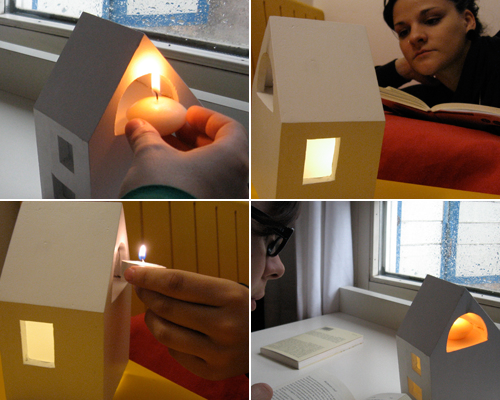
Over the last few years, there are more and more interaction designs that have been widely discussed in HCI community. However, most research focuses on the functionality or usability, but fewer on construction of meaning in interaction. We manifest a social computing design, Liaison Ceramic. Our intention is to unfold a new form of interaction in terms of the everyday practice through a house-like lamp, which can range from embodiment to personal meaning and social meaning. Through placing a candle onto one roof of the lamp to achieve a perceptual conversation, a user and his/her friends could be involved in at the same time, and keep in touch in the different space. The main study described the phenomenon of using our product in the life world. Besides, it’s also an alternative form of embodied interaction to enrich everyday experience. We argue that, moreover, our design itself is not a physical form used to light up only, but rather a perceptual medium to warm up the communication of users and their friends. In particular, we put emphasis on how this everyday practice provides us a new kind of user experience. We would expect that our design could be an exemplary of embodied interaction. Further, this research should contribute understanding of embodied interaction to the HCI community.


Draft of Oct. 2012 by Chung, Wei-Ming (D10010301)

2012年11月5日 星期一

week 8. the logic of annotated portfolios


The logic of annotated portfolios: communicating the value of 'research through design'

摘要:
1. "Limited rationality"  在 RtD 中的重要性
2. abstraction 的不可行性
3. 科學正規化設計的不可行性

1. p. 68
Cooper and Bowers: Human Computer Interaction (HCI) in terms of two conceptual and historical 'waves'.

First Wave HCI predominately used the
methods and theories of experimental cognitive psychology
to understand such scenarios. First Wave HCI tended to be
critical of perceived tendencies in ergonomics and software
engineering to not take the user seriously as an active
cognizing individual. In contrast, according to Cooper and
Bowers, Second Wave HCI was critical of the First Wave
for not capturing the social identity of the user, the social
organization of the user’s activities, and the social context
of computing technology. The growth of Computer
Supported Cooperative Work (CSCW) as a research field
was cited as emblematic of Second Wave concerns.

the Third
Wave is characterised by non-work settings and topics such
as lived-experience, intimacy, pleasure and embodiment.

 notice: embodied interaction 通常不是 work settings, 所以 1st 的 experimental cognitive psychology 和  2nd 的 Computer Supported Cooperative Work (CSCW) 並不適合.

2. Manifesto Pieces  in HCI

   Ludic Design (Gaver)
   Reflective Design (Sengers)
   Ambiguity  (Gaver)

3. p. 69

RtD 的源頭: (RtD 只看 artefact, 認為 thinking 會自己出現在 artefact 中)


This phrase
has its origins in Frayling [11] and denotes “research where
the end product is an artefact – where the thinking is, so to
speak, embodied in the artefact, where the goal is not
primarily communicable knowledge in the sense of verbal
communication, but in the sense of visual or iconic or
imagistic communication.”

4.

Gaver warns against
importing inappropriate standards from other disciplines,
but unlike them, he does not map design research so as to
develop anxiety-relieving ‘criteria for rigour and
relevance’. Instead, he is concerned to head off (阻止) a creeping (躡手躡腳的)
scientism’ he fears may lurk (潛伏) behind such anxieties or be
crudely seen as their remedy.


Gaver gives various characterisations as to
what design theory could be – “generative”, “suggestive”,
“provisional”, “aspirational”, “annotative” – which point to
a very different identity from the explanatory and testable
theories which dominate thinking about science.


Feyerabend’s Against Method is a subtle
philosophical argument against adopting universal
standards for conduct in the sciences.

...Rather, Feyerabend is urging us to be aware of
the limits of all rationalisms.

5. p.70


Textual accounts (published papers, documents,
descriptions, catalogue entries, whatever) in RtD have an
indexical character. That is, they point to features of
artefacts of interest and connect those features to matters of
further concern. They highlight features and make them
topical for discussion within a given community.


Barthes [2] made
analogous points about how photographs and text (e.g.
captions) interrelate in newspaper and magazine articles.
The text points to features of interest and establishes
connotations’ (言外之意) with other concerns not explicitly depicted.


Gaver [12] puts it that textual accounts of artefacts,
including any theoretical pronouncements about them, are
to be seen as  annotations.  He continues: “Beyond single
artefacts, however, annotated portfolios may serve an even
more valuable role as an alternative to more formalised
theory in conceptual development and practical guidance
for design. (AP 比正式理論更有價值)


If a single design occupies a point in design
space, a collection of designs by the same or associated
designers – a portfolio – establishes an area in that space.
Comparing different individual items can make clear a
domain of design, its relevant dimensions, and the
designer's opinion about the relevant places and
configurations to adopt on those dimensions.”


6. p. 71

OVERVIEW

...


  • Typically a portfolio can be annotated in several different ways reflecting different purposes and interests and with different audiences in mind. 


  • Annotations and the designs they annotate are mutually informing. Artefacts are illuminated by annotations. Annotations are illustrated by artefacts.

...


Annotations 
are a major resource for creating a portfolio. Works do not 
speak for themselves. They are annotated so as to show
how they fit into a portfolio of related endeavour.


7. p. 73

Annotations can configure use, appreciation, aesthetics, and
scientific value, as well as suggesting future research and
design possibilities. An annotated portfolio is a pragmatic 
thing. It is not an abstractly organised collection of work. I
have already said that how we annotate and how we select
works for inclusion in a portfolio reflects interests and 
purposes. Interests and purposes are future-looking. They
shape what we can expect people to do with designs
(questions of use and usability), how they will appreciate
and value designs (questions of aesthetics), and what
knowledge we can expect to derive from all this (questions
of science, broadly construed).


8. p. 75

CONCLUSION


Having situated Research Through Design (RtD) as a
characteristic contribution to Third Wave HCI, this paper
has noted the disciplinary anxieties [8] that this research
tendency has given rise to.


p.76


Annotations were characterised as indexically
connected to artefacts, while connoting topics of broader
interest to whatever the intended audience might be.


An annotated portfolio has a self-conscious logic of limited 
rationality. Any particular set of annotations is perspectival,
allowing other annotations to be made. Annotations allow
family resemblances to be reasoned about, rather than
deductions made. Annotations help us understand what has
made a body of work characterful.


Annotations have weak explanatory and predictive power
and tend to be local to a particular portfolio of work. This is
a (welcome) feature of their limited rationality.


Annotated portfolios relate to past occurrences and future  possibility in a different fashion than that suggested by the  notions of explanation and prediction commonly discussed  regarding theory.

Annotated portfolios are  descriptive (of past occurrences) and intended to be  generative inspirational (of future possibility) with their primary  business constituting a portfolio in close contact to the existing ‘ultimate particulars’ [12, 33] of design – the actual  artefacts themselves. This dual of descriptive/generative is,  perhaps, a more truthful designerly orientation to past/future than explanatory/predictive.


descriptive/generative v.s. explanatory/predictive.


9.


Annotated
portfolios insist on the indexical ties between texts about
designs and the designs themselves. Annotations and actual
artefacts are seen as mutually explicating and illuminating.
In this sense,  annotations are not abstractions as they
cannot be ‘dragged away from’ the particularities of actual
artefacts (abstraction deriving from the Latin  abtraho
meaning ‘I drag away’). They retain their attachment.

Gaver 對科學解釋的疑慮, 在高壓的學派政治壓力下:


Gaver [12] is suspicious of the potentially coercive (高壓的)
disciplinary politics behind attempts to normalise design
research through a more ‘scientistic’ construal of what HCI
should be about.


Ref:

http://www.mce.ndhu.edu.tw/~gimewww/epaper/9501/epaper9501.htm#explain