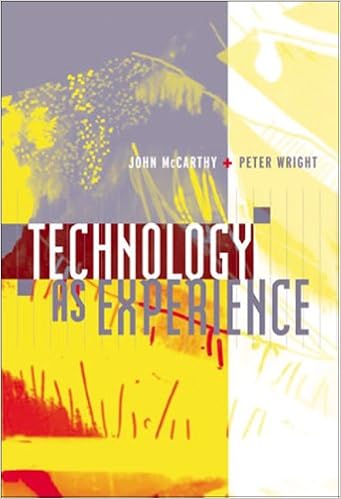
Featured:
Chapter 1 Living with Technology: The User as a Cog in a Virtual Machine (During the 1970s and the 1980s the dominant approach to understanding relationships between people and technology assumed a single user sitting in front of a computer screen and keyboard performing a fairly well prescribed
task.) The User as a Social Actor (During the late 1980s and the 1990s the opportunistic or contingent aspects of everyday activity became the central focus of challenges to the dominance
of information-processing psychology.) Consumers and the User Experience (The 1990s saw the development of the dotcom companies and a multimillion-dollar games industry; strong penetration of computers into the
home; the confluence of computer and communications technologies; and the beginnings of wireless, mobile, and ubiquitous computing.) Toward a Deeper Understanding of Technology as Experience: 6 propositions
Our first proposition is that, in order to do justice to the wide range of influences that technology has in our lives, we should try to interpret the relationship between people and technology in terms of the felt life and the felt or emotional quality of action and interaction. (p. 12)
Our second proposition is that social-practice accounts of interactive technologies at work, at home, in education, and in leisure understate the felt life in their accounts of experiences. (p. 14)
主張三:
我們的第三個主張是,用技術來描述親身感受的經驗,是困難的。
Our third proposition is that it is difficult to develop an account of felt experience with technology. (p. 15)
Our fourth proposition is that pragmatist philosophy of experience is particularly clarifying with respect to experience, and that the models of action and meaning making they encompass express something of felt life and the emotional and sensual character of action and interaction. (p. 17)
Our fifth proposition is that the importance given to the emotional-volitional and creative aspects of experience in pragmatism prioritizes the aesthetic in understanding our lived experience of technology. (p. 18)
主張六:
我們的第六個主張也是最後一個主張, 建立實用主義的修訂理論,特別有益於理解技術與設計。
Our sixth and final proposition is that the revisionary theorizing of pragmatism is particularly valuable for understanding technology and design. (p. 19)
Feature Chapter 3 A Pragmatist Approach to Technology as Experience: Background to Pragmatism and Experience John Dewey(1859–1952)
Enriching Activity through Aesthetic Experience
Dialogicality Bakhtin
1. Embodiment is the property of being manifest in and of the everyday world. Embodiment constitutes the transition from the realm of ideas to the realm of everyday
experience. (p. 8)
2. Embodiment, then, denotes not physical reality but participative status. When I talk of “embodied interaction”, I mean that interaction is an embodied phenomenon. It happens in the world, and that world (a physical world and a social world) lends form, substance and meaning to the interaction. (p. 8)
3. It (tangible computing) also tries to make computation manifest to us in the world in the same way as we encounter other phenomena, both as a way of making computation fit more naturally with the everyday world and as a way of enriching our experiences with the physical. (p. 8)
5.1 The Phenomenological Backdrop
1. Husserl argued that everyday experience is of concrete phenomena, and it is from such experience and phenomena that our conception of number and of mathematics exists. Phenomenology, then, was based in the phenomena of human experience, in contrast to the abstract entities at the heart of scientific and mathematical
practice. (p. 9)
2. For Heidegger, everyday experience happened not in the head, but out in the world.
Heidegger’s “hermeneutic phenomenology” rejected the detached, mentalistic intentionality of Husserl’s “transcendental” form. (p. 9)
3. Where Husserl had conceived of a progression from perception to
meaning to action, Heidegger stressed how we ordinarily act in a world that is already organised in terms of meaning and purpose. Heidegger took “shoot first, ask questions later” not as an imperative, but as a description of our mode of being. (p. 10)
4. Heidegger’s distinction between “ready-to-hand” and “present-at-hand.”
Heidegger argued that the ontological structure of the world is not a given, but arises through interaction....The critical thing to observe here is that this can happen only through involved, embodied action. Winograd and Flores use this to illustrate
that activity is constitutive of ontology, not independent of it. (p. 10)
5. ...the concept of “embodiment” features perhaps most strongly in the phenomenology of perception developed by Maurice Merleau-Ponty (1962). Merleau-Ponty saw perception as an active process, and one carried out by an embodied subject. The embodied nature of action (and actors) was central to Merleau-Ponty’s philosophy. (p. 10)
6. Foundations
1. What does phenomenology have to tell us about interaction? For the purposes at hand, I take three main points from this work: that interaction is physically and socially embodied; that ontology arises out of activity; and that meaning subsists in embodied action. (p. 12)
2. The relationship between action and meaning is, in many ways, the crucial one here...., the two pillars supporting a foundational model of interaction are intentionality and coupling. (p. 12)
3. Intentionality, loosely, is “about-ness.” It describes a referential relationship between two entities. Words, images and ideas are intentional phenomena; they are about things, in a way in which rocks, carpets and trees are not.Intentionality is the essence of how entities bear meaning.Coupling refers to the degree of coordination of two elements, and to how that coordination is maintained. (p. 12)
4. ...the meanings assigned to the objects in the interface depend on the coupling
of actions. Coupling and intentionality are directly related. By implication, then, in order to manage meaning, we must be able to manage coupling.(p. 12)
5. Coupling, then, is at the heart of our ability to work with artifacts and control them. Intentionality is an everyday phenomenon; arguably, it is the phenomenon of human experience, which works its way out in the interactions in which we engage with the world and with each other. It is rooted in our socialisation and our lives as social animals in a web of social and cultural relations which give meaning to everyday action. Fluid coupling provides us with the means to negotiate this web.
Embodiment lies in the relationship between the two. (p. 12)
6. What tangible computing does, by moving computation out into the world, is to open up new ways for us to be coupled to the intentional phenomena of computation.
In particular, it provides new ways for us to explore them. What turns out to be important about tangible computing, then, is not the physical nature of the objects through which we interact, but with what they represent and how we use them.
At the same time, social computing emphasises how context lends meaning, and places a primary emphasis on action rather than abstract representation.
Embodied interaction provides us with a perspective on computational representation that takes action as a primary constituent.
7. Conclusions
Embodied interaction, then, suggests that the future of interaction lies not in the interface “disappearing”, but rather in the interface becoming even more visible, or rather, available for a wider range of engagements and interactions. The question is, what form will that heightened visibility take? (p. 14)
Short report (within 300 words):
Describe the above embodied interaction with a phenomenological approach.
(note: describe it in terms of intentionality, coupling, meaning, everyday experience, human experience, social computing, embodied action, everyday world, phenomena, felt experience, encountering, rich experience, embodied perception...)
Deadline: Oct, 1st, 2019
upload to "10月1日體現互動摘要" on google drive
1. Chen, H.-C., Lin, Y.-C., & Liang, R.-H. (2013). Study through designing reminiscing activities for the elderly. Digital Creativity, Vol.24, No. 4, p.p. 327-341.
2. Bowen Kong, Wenn-Chieh Tsai, and Rung-Huei Liang. 2019. Confabulation Radio: Reflexive Speculation in Counterfactual Soundscape. In Extended Abstracts of the 2019 CHI Conference on Human Factors in Computing Systems (CHI EA ’19). ACM, New York, NY, USA, Paper LBW0141
3. Wenn-Chieh Tsai, Po-Hao Wang, Hung-Chi Lee, Rung-Huei Liang, and Jane Hsu. 2014. The reflexive printer: toward making sense of perceived drawbacks in technology-mediated reminiscence. In Proceedings of the 2014 conference on Designing interactive systems (DIS ’14). ACM, New York, NY, USA, 995-1004.
4. Wenn-Chieh Tsai, Daniel Orth, and Elise van den Hoven. 2017. Designing Memory Probes to Inform Dialogue. In Proceedings of the 2017 Conference on Designing Interactive Systems (DIS '17). ACM, New York, NY, USA, 889-901.